Engineering Manager - UK
Quick Summary
Hi 👋 I’m Colin, Director of Engineering, Europe. How do you feel about software engineers writing product specs, making product decisions, and not breaking down projects into individual tickets?
Hi 👋 I’m Colin, Director of Engineering, Europe. How do you feel about software engineers writing product specs, making product decisions, and not breaking down projects into individual tickets? If that sounds exciting (even if a bit scary), read on because I’m looking for an engineering manager to help us build a different type of engineering team and culture at Ashby.
To start, why do we need to be different? Time and again, I have witnessed engineers knowing what needs to be done yet being unable to get things done because of “the process” or because “more data is needed.” Some of the most effective projects have been skunkworks projects, where engineers have taken total ownership of a problem and driven it to completion. I want to normalize that at Ashby.
When we think about how these processes came about, we realize they carry a pessimistic mindset. They box people into smaller roles to minimize the chance of not meeting a certain standard. At Ashby. we’re building an environment that is optimistic about what engineers can own and achieve and embraces the innovative engineers (and frankly, often stays out of their way).
To accomplish this, our engineering leaders need to think deeply about individual performance, process, and culture - not running sprint planning or driving product and technical decisions. You’ll focus on building your team, their skills to thrive with the ownership they’re given, and an environment that empowers them to do their best work consistently, with little distraction. For junior EMs we try to stay within 6 direct reports. This enables them to spend time with our teams observing, correcting, praising, and, yes, coding. We like our managers to be hands-on while also making sure they’re not on the critical path.
We’ve already gathered an experienced, talented, and collaborative team of 25+ engineers. You’ll help me manage the growing team of engineers in Europe.
In addition to working with engineers you’ll also get to work on projects yourselves. Some examples of work our engineering leaders have done:
Provide feedback on product and technical specs to help engineers identify where to cut scope or improve quality. You don’t make the final decisions, but you’ll influence and coach ICs to reach the right ones.
Grow engineers to the point where they can take large, loosely defined projects, and deliver them with little intervention. They still ask for help when needed - the difference is that they’re driving.
Jump into our systems and code to debug a customer issue, ship a small bug fix, or improve our developer experience. Engineering leaders at Ashby are great engineers and enjoy keeping their skills up-to-date (while staying off the critical path).
Improve how we generate and simulate data in demo accounts. It’s a project off the critical path, but it helps you keep up-to-date on our codebase while immensely impacting the business, from Engineering to QA to Sales.
I had two experiences early in my career that set me on my path. I had a great manager who asked tonnes of questions about the decisions I was making and coached me without me realizing it. And I had a terrible manager - being told to work harder after a week of 3am finishes was not what I needed as a young engineer. The stark difference between these two experiences motivated me to become a manager: I wanted every engineer I worked with to have the support I had in the best case.
Since then, as I’ve learned more, I’ve realized that I love the kind of problems I get to solve as a manager. Deeply complex problems with long-term impact both on the company and on people’s lives. One of my proudest achievements is creating a fully transparent pay system, and on the day it was revealed, everybody was happy with it. Nobody stormed out. By spending time thinking deeply about everybody’s pay and ensuring the mechanics of promotion were clear, I put the team in a place where they could see a peer was paid more than them, and it not be a problem.
Despite all this, I love being technical. I sometimes indulge myself and spend a morning writing some code to improve tests or provide better abstractions. If I couldn’t be a manager, I’d be super happy to be an IC.
I’m looking for someone who is passionate. Passionate about both management and being technical. Someone who spots a pattern amongst their team, figures out a better way for us to operate, and then builds the automation that powers it. I introduced a new process that enables engineers to merge 30% of PRs without a human review beforehand. I also built the automation that approves these PRs. I also built that automation with abstractions that make it easy for the engineers to improve the automation themselves.
It can be hard to find seasoned engineering leaders who haven’t succumbed to the status quo in some way or another. We're committed to giving all our people a total and utter lack of terrible managers, and that means we're willing to take a chance on someone early in their leadership journey who's courageous, principled, and has the drive to build themselves into a great leader who can say “Yah I know everyone is doing that, but we won't because...”
As engineers, we are used to tooling that makes us better at what we do. When we started Ashby, we saw the opposite with Talent Acquisition (TA) software. Recruiting teams were leveling up how they did their work, but instead of software meeting this new standard, it held them back.
Scheduling a final round is an excellent example. Recruiting teams wanted to schedule candidates faster, track interviewer preparation and quality, and do it with half the headcount. A recruiter needed to manually collect availability from the candidate, identify qualified interviewers, perform “Calendar Tetris” to find who is available to interview the candidate, schedule on the earliest date possible, and make any last-minute adjustments as availability changed. They must do this while considering the interview load on each individual and whether interviewers need to be trained and shadowing others. 🥵 TA software didn’t help.
As hiring managers, we know TA is a critical function, and as engineers, we know software can do better. So, we built and continue to build Ashby to give TA teams the highest standard of tooling. Software that’s intelligent and powerful. Software that provides insights into where they’re failing and automates or simplifies many of the tasks they’re underwater with. We want other functions and departments to be jealous of what TA teams can do with Ashby, and today they often are!
As we’ve set the standard for excellence in TA software, HR teams have pulled us into solving their problems in areas like onboarding and performance management.
Engineering leadership comes in many flavors, not all of which fit our model. I thought I’d outline some things I’m looking for to help you decide if this fits what you’re looking for:
You love being technical and can hold in-depth conversations with direct reports from infra to backend to frontend.
You enjoy management problems. We want people who get excited about driving people to be their best, giving difficult feedback, and building systems that make this easier
You hold your team to a high standard and don’t shy away from getting into the details and giving feedback, even to the best folks on your team.
You are an excellent and empathetic communicator. Facilitating change at both an individual and organization level requires understanding how to navigate the beliefs, opinions, and past experiences of engineers and figuring out how to both convince them of a new way of doing things while also leaving yourself open to feedback.
You know what exceptional engineers look like. You’ve thought deeply about what makes them tick, how to recruit them, and how to grow folks into them. I want to see depth here, the industry often regurgitates a vanilla description, but the reality is more nuanced.
You’re good at thinking about product, business, and maybe even design, but you’re not interested in calling the shots and are more interested in building a team that can make the best decisions without you.
You thrive in high-trust, high-autonomy environments. We're a young startup where leaders wear multiple hats, and you'll build your own (high-speed) on-ramp through developing strong feedback loops.
You don’t enjoy coding or don’t find time to stay up-to-date on technology.
You’ve gotten into management because it was the only growth path available
You want to make all the product decisions instead of empowering your team to make those calls.
You're happy with a team of engineers that are predominantly early-career, mid-career, or don't thrive with ownership or autonomy. With enough guardrails, the team can get things done.
A staff or principal engineer to you is someone who spends most of their time project managing or doing architecture reviews.
You’re not optimistic or convinced that we can build a large engineering team that functions differently than the status quo. You think, at some size, common processes need to be implemented to ensure consistent product delivery (e.g., sprint planning, product managers writing in-depth specifications). You might not say it out loud, but you think, at some size, compromises have to be made for the sake of hiring numbers.
Our engineering culture is motivated by Abhik and Benji’s (our co-founders) belief that a small talented team, given the right environment, can build high-quality software fast (and work regular hours!). We do it through:
Minimal process with ownership over decisions normally made by product and design
Natural collaboration and deliberate communication
Investing in tools and abstractions that give us leverage
Putting effort into building a diverse team
The best engineers we’ve worked with delivered reliably magical outcomes. They took customer problems and relentlessly drove them to solutions that were not only successful but often brilliant and creative. While they did this with minimal oversight, stakeholders were never in the dark as to what was going on, and no setback was a surprise.
Traditional product-development processes aren’t meant for the best engineers. Their purpose is to create consistent outcomes regardless of the engineer’s skill. But, consistency comes at the expense of an engineer’s time and freedom—both ingredients necessary to generate those magical outcomes. As a result, process stifles the best engineers and doesn’t give others the opportunity to practice the behaviors that made the best engineers the “best.”
At Ashby, we want to build an environment that encourages every engineer to be their best. So, at Ashby, every Engineer runs their project. Product Managers (and Designers) build strategy, do customer research, and hand off problem briefs to Engineers. Engineers take on the rest: they research the problem, write product specs, build wireframes, and implement their solution end-to-end. We rely on engineers, not process, to push information outward to the relevant folks (e.g., Product Managers) and pull folks in to help (e.g., Designers, Infra). It’s a new level of ownership for many engineers, but we’d rather an engineer fail a bit and coach up their skills than use process as a crutch. Not everyone succeeds in our culture, but those who do thrive.
Our engineering team consists of lifelong learners who are talented but also humble and kind (meet them here!). These attributes create an environment where collaboration happens naturally. We combine this with research, prototyping, and written proposals to see around corners and get feedback from the team across time zones. Focus time is something that we hold sacred, and, with thoughtful and deliberate communication, engineers are in <2h meetings per week (I wrote about it here).
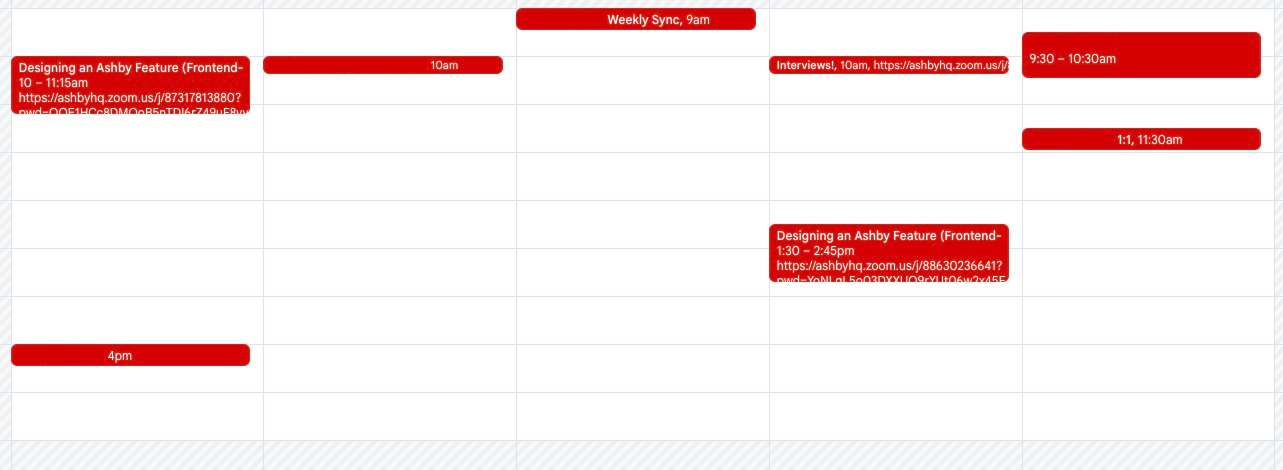
To drive it home, here's a recent calendar of an engineer who has been with us for over 4 years. ~34 hours of focus time, 2.5h of interviews, and 3.5 hours of meetings:
We also meet in person at least twice a year, once as a department and once as a company. You also have a small budget to meet up with folks in your city/region.
We built Ashby with the quality, breadth, and depth that many customers would expect from much larger teams over larger time scales. We’ve done this through investment in:
Great developer tooling. Our CI/CD takes ~10m, and we deploy at least 15x a day. A debugger that works out of the box. Everyone on the team has contributed to our developer experience 💪🏾.
Building blocks to create powerful and customizable products fast. At the core of Ashby is a set of common components (analytics modeling and query language, policy engine, workflow engine, design system) that we constantly improve. Each improvement to a common component cascades throughout our app (short video below).
AI-powered tooling. We think of AI as a way to automate the mundane parts of building and maintaining high-quality software. We use a combination of third-party and internally built tools that, for instance, auto-triage customer issues, suggest fixes, prototype ideas, generate production-ready code, and conduct code reviews. Engineers have an unlimited token budget (but are not measured on it). We write in detail about our philosophy, current use of AI, and future plans for AI in Engineering here.
Here’s an impromptu quote from Arjun in our company Slack of what it’s like to build a feature at Ashby:

And a demo of one of these building blocks:
Diverse teams drive innovation and better outcomes. Having seen my mother and partner build their careers as minority women in non-diverse fields, I want to make sure Ashby creates opportunities for the next generation of engineers from underrepresented groups.
Today, 25% of engineers and 50% of our engineering leaders at Ashby are from underrepresented groups. We are taking conscious steps to improve, like sourcing diverse candidates, providing generous paid family leave, no leetcode interviews, and more.
The intensity of work at Ashby should feel like a marathon, not a sprint (nor speed-walking). We work with urgency and ambition to build excellent software, but we don’t need to prove out a new software category or product-market fit. That requires ingenuity and thoughtfulness, and that doesn’t happen with unrealistic deadlines or sleepless nights.
Our remote, low-meeting, high-ownership culture gives you a lot of flexibility in how you structure your days and weeks. In practice, that means you keep your own hours, but there will be moments of intensity, like launching your feature at our annual user conference. We offer unlimited PTO, and you actually get to use it. Some of our most exceptional engineers take almost 30 days of vacation per year.
This way of working allows many of us on the team to be active parents, including Benji and Abhik. Abhik blocks off 1.5 hours every morning to spend with his daughter and drop her off at school. Mujda (Product Engineer) puts it best in an article about us: “I can say that Ashby is a great place to be a mom… No one bats an eye if I have to take my kid to a doctor’s appointment or have to work weird hours because childcare fell through.”
At Ashby, our team and interview process want to help you show your best self. We’ll dive into past projects and simulate working together. Our interview process is six interviews in the following order:
Intro Call (30m) - Discuss your application questions, align on the responsibilities of the role, and answer questions about Ashby.
Past Experience Deep Dive (1h) - Discuss your past experience as an engineering leader.
Technical Screen (1h) - Add a feature back to Ashby. You'll spend most of your time understanding a specific part of our codebase and write less than 15 lines of code.
Coffee Chat with VP of Engineering (1h) - Spend time with our VP of Engineering and get to know each other.
Meet the Team (2h) - At this point, the engineering leadership team is excited about you and you'll meet our CEO, Engineers, Product Managers, and some other folks on the team.
I will be your main point of contact and prepare you for interviews. If we don’t give an offer, we’ll provide feedback!
I’m sharing our tech stack with the caveat that we don’t require previous experience in it (but a love of typed languages is helpful 😀): TypeScript (frontend & backend), React, GraphQL API, Node.js, Postgres, Redis.
When they joined Ashby, many of our engineers switched from other languages like Swift and Kotlin (Ben), platforms like iOS (Tom) and Windows (Adam). We care more about fundamentals (e.g., debugging, abstractions) and how fast you learn. For folks on the team who switched, it's nice seeing changes hot reload versus waiting for XCode to compile 😅.
What We Offer
~2 min readLocation & Eligibility
Listing Details
- Posted
- April 1, 2025
- First seen
- May 5, 2026
- Last seen
- August 28, 2026
Posting Health
- Days active
- 104
- Repost count
- 0
- Trust Level
- 35%
- Scored at
- August 18, 2026
Signal breakdown
Please let ashby know you found this job on Jobera.
4 other jobs at ashby
View all →Explore open roles at ashby.
Similar Engineering Manager jobs
View all → Chime
Chime NextivaRemote
 Lyft
LyftBrowse Similar Jobs
Stay ahead of the market
Get the latest job openings, salary trends, and hiring insights delivered to your inbox every week.
No spam. Unsubscribe at any time.