PhD Proposal : Decision support for the strategic planning of industrial investments under multidimensional uncertainties in an aeronautical technological disruption context - CDD 36 months
 France·Albimid
Quick Summary
1. Global Context The aeronautical industry is undergoing a period of simultaneous disruption across three critical dimensions for aeronautical suppliers. First,
The aeronautical industry is undergoing a period of simultaneous disruption across three critical dimensions for aeronautical suppliers. First, the emergence of new aircraft platforms has created a need for novel parts and manufacturing processes whose industrial mastery and profitability at scale remain uncertain. At the same time, tightening regulatory requirements regarding certification, environmental standards and quality norms are reshaping the eligibility conditions for investments over horizons that exceed manufacturers’ usual decision cycles. Finally, demand volatility, amplified by the reshaping of global competitive balances, creates uncertainty over volumes and positioning that undermines any multi-year investment plan.
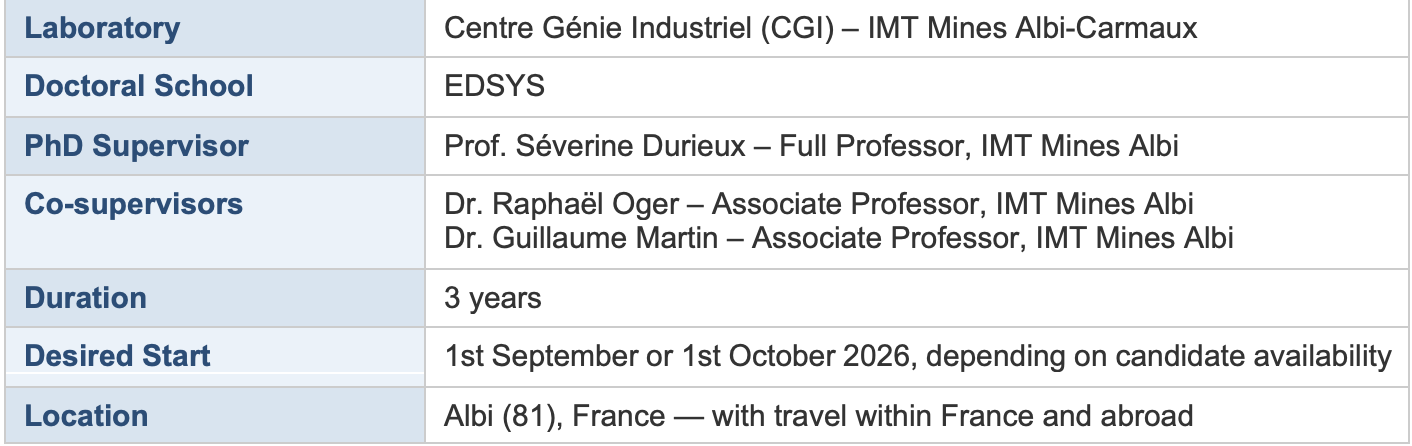
This thesis is funded by an aeronautical sub-contractor. It aims to equip decision-making teams with a rigorous methodological framework to address a central strategic dilemma: how to arbitrate between maintaining and optimising current processes (existing assets, established competencies, known return on investment) and committing to new processes whose technological maturity, total cost and normative acceptability remain partially unknown? This tension between the resilience of existing assets and strategic agility constitutes an investment problem under deep uncertainty.
This dilemma arises in an environment where available data are fragmentary, uncertainties are heterogeneous in nature (some quantifiable, others deep and non-parametrisable), and where several business functions — manufacturing, finance, R&D, supply chain, quality — must jointly build investment scenarios with differentiated time horizons and performance criteria.
Current decision processes face three major challenges:
• Uncertainty heterogeneity: uncertainty factors relating to demand (stochastic), regulation (scenario-based) and technological maturity are not of the same nature and cannot be handled by a single formalism;
• Resilience vs. agility tension: existing assets provide operational stability but reduce the capacity to seize emerging opportunities; models are therefore needed to jointly quantify and arbitrate these two dimensions;
• Poorly equipped multi-function governance: multi-year decisions involve actors with differentiated attitudes towards decisional risk, for whom protocols are required to rigorously and legitimately aggregate their heterogeneous preferences and make a decision explicable.
The central objective is to design and validate a multi-year decision-support framework for industrial investments, enabling multidisciplinary teams to:
• Formally represent multidimensional and heterogeneous uncertainties within a coherent, non-reductive mathematical framework;
• Evaluate and compare the resilience of investment strategies against scenarios including hard-to-foresee shocks;
• Formalise dynamic strategies that minimise risks and maximise opportunities despite the combinatorial explosion of scenarios;
• Make informed collective decisions within a multi-criteria, multi-viewpoint logic, integrating the heterogeneous attitudes of decision-makers towards decisional risk.
The primary application domain is investment decision-making for manufacturing processes in an aeronautical sub-contracting company (existing vs. new processes), a context that concentrates industrial strategy, technology risk management and multi-actor coordination challenges.
Which formalisms (possibility theory, fuzzy sets, info-gap, imprecise probabilities, etc.) enable the joint representation of uncertainties of different epistemic natures (stochastic, scenario-based, latent) without artificially homogenising them as random noise or producing an unmanageable state space?
What compatibility conditions and aggregation operators enable the coupling of heterogeneous representations within an operational decision model, limiting combinatorial explosion to a number of variables that is both decision-relevant and usable by an industrial committee?
What metrics and evaluation protocols make it possible to characterise a strategy’s resistance to shocks outside the known probabilistic support?
Which sequential decision models (multi-stage stochastic programming, reduced decision trees, compound real options, etc.) enable the simultaneous integration of existing asset preservation and emerging opportunity capture, while remaining usable by a multidisciplinary industrial committee?
What frameworks enable the formal output of an operations research (OR) model to be articulated with the actual dynamics of a multidisciplinary decision committee?
What decision-support tool architectures simultaneously deliver a rigorous analytical layer and an interpretable layer for non-OR-expert decision-makers, while integrating the elicitation and explicit modelling of the heterogeneous preferences of multi-function stakeholders?
The scientific barriers concern the fundamental knowledge that must be built or extended in order to provide a rigorous response to the research problem.
Uncertainties relating to demand (stochastic), regulation (scenario-based) and technological maturity (latent) are of radically different epistemic natures. No single formalism can represent them jointly without either artificially homogenising them as random noise (probabilistic reductionism) or producing an unmanageable state space for practical decision-making.
Even with formalisms suited to each type of uncertainty, their coupling within a coherent decision model remains an open barrier. Existing aggregation operators (expectation, min-max, Choquet capacity, for example) are not designed to handle hybrid distributions (probabilistic + possibilistic + scenario-based) within a framework with a controlled number of variables.
Resilience cannot be reduced to statistical robustness. Evaluating an investment strategy’s capacity to absorb, adapt and reconfigure in the face of shocks outside the known probabilistic support requires specific metrics and evaluation protocols. A scenario generation strategy covering the uncertainty space is required.
Multi-year sequential decision-making generates a combinatorial explosion of scenarios as soon as optionality, reversibility and investment sequencing are simultaneously integrated. Existing models (multi-stage stochastic programming, decision trees) quickly become unsolvable within the timeframes available to industrial committees. Real options offer a promising avenue, but one insufficiently adapted to industrial constraints.
Industrial decision-making is not a pure optimisation problem. It mobilises heuristics, cognitive biases, institutional constraints and organisational legitimacy logics. Classical OR models produce formal outputs that decision-makers fail to appropriate, due to a lack of transparency in the solution derivation process.
Designing a tool that simultaneously delivers a rigorous analytical layer and a layer interpretable by non-OR-expert decision-makers, while explicitly modelling heterogeneous preferences (risk aversion, ambiguity tolerance, differentiated time horizons) of multi-function stakeholders, constitutes a technical, cognitive and organisational barrier.
The research methodology will combine five complementary strands:
• Literature review spanning operations research, robust and stochastic optimisation, real options theory, multi-criteria decision analysis (MCDA) and behavioural decision theory;
• Formalisation of a conceptual framework categorising uncertainties and decision criteria specific to aeronautical sub-contractor investments, validated with the industrial partner;
• Development of multi-year optimisation models integrating real options, robustness and resilience mechanisms, calibrated on real industrial cases, while minimising the associated combinatorial explosion;
• Experiments with multidisciplinary teams from the industrial partner, first in controlled conditions and then in real investment decision situations;
• Quantitative and qualitative evaluation of the framework and tool: decision quality, cross-function adoption, cognitive load, recommendation robustness.
The thesis is structured over three academic years, progressing according to the hierarchy of research questions: theoretical foundations and industrial framing (AY1), methodological architecture and modelling (AY2), operationalisation, field validation and writing (AY3).
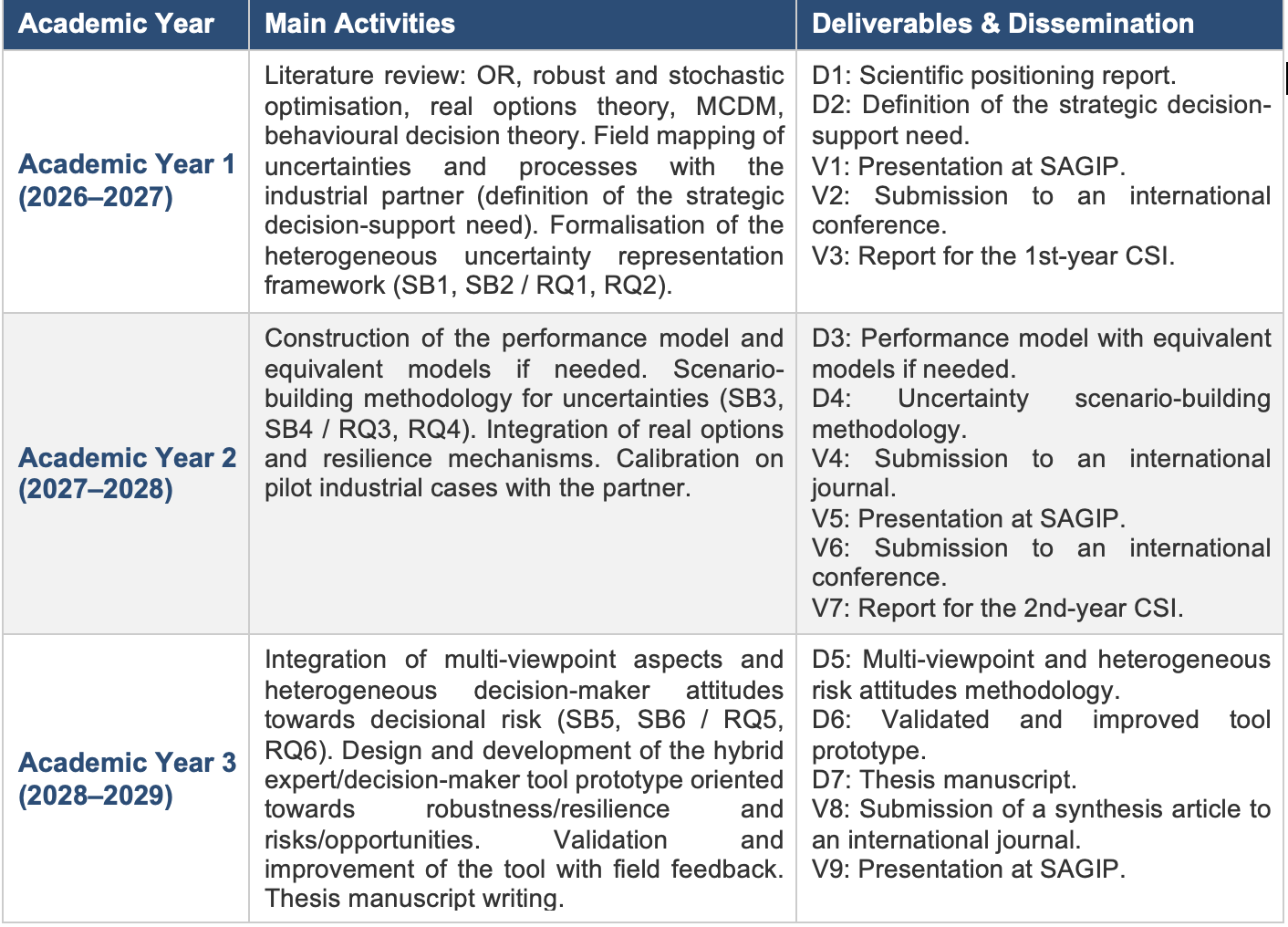
• D1 — Scientific positioning report.
• D2 — Definition of the strategic decision-support need, validated with the industrial partner.
• D3 — Performance model with equivalent models for uncertainty representation.
• D4 — Uncertainty scenario-building methodology, calibrated on real industrial cases.
• D5 — Methodology for integrating multi-viewpoint aspects and heterogeneous decision-maker attitudes towards decisional risk.
• D6 — Hybrid expert/decision-maker decision-support tool prototype, oriented towards robustness/resilience and risks/opportunities, validated and improved through field feedback.
• D7 — Thesis manuscript (AY3).
• Dissemination: presentation at SAGIP each academic year; submissions to at least one international conference; 2 publications in an A-ranked international journal.
Candidates must hold a Master’s degree (or equivalent) in one of the following fields:
• Industrial engineering, operations research or decision systems engineering;
• Applied mathematics, statistics or computer science with a specialisation in optimisation.
• Technical: strong foundations in optimisation (mathematical, stochastic or robust programming), interest in MCDA methods and uncertainty modelling;
• Scientific: ability to conduct rigorous literature reviews, formalise conceptual models and design experimental protocols in collaboration with an industrial partner;
• Personal: enthusiasm for complex industrial problems, ability to work in multidisciplinary research teams, autonomy and intellectual rigour;
• Languages: fluency in French (working language); operational level of written and spoken English for scientific writing and international communications.
A school under the French Ministry of Industry, IMT Mines Albi belongs to the Institut Mines-Télécom, France’s leading group of engineering and management schools. Its positioning makes it the reference institution for responsible industry of the future, energy and systems engineering.
The Centre Génie Industriel (CGI) has approximately 70 members. It focuses on supporting ecosystem transitions by enabling responsible and sustainable decisions in unstable or disrupted environments. The research axes relevant to this thesis are: FLOWS (Flexible Logistics and Operations for sustainable WorldS) and HOPOPOP (Hybridization for Operations & Planning, Organizations & Performance, Optimization & Problem-solving).
The PhD requires close collaboration with an aeronautical company. Opportunities for academic exchange at a European partner institution will depend on the progress of the doctorate and mobility calls issued by EULIST.
• Séverine Durieux – severine.durieux@mines-albi.fr
• Guillaume Martin – guillaume.martin@mines-albi.fr
• Raphaël Oger – raphael.oger@mines-albi.fr
Required documents: CV, cover letter, Master’s thesis summary, copies of publications, transcripts, letters of recommendation (research and industrial experience) and any other document deemed useful to support your application.
Application deadline: 21 June 2026, 12:00 PM
Robust optimisation • Deep uncertainty • Real options • Resilience • MCDA • Multi-year decision • Multi-criteria • Industrial investment • Aeronautical sub-contracting • Decision support
Operations Research / Industrial Engineering / Decision Support
Centre Génie Industriel (CGI) — IMT Mines Albi-Carmaux
FLOWS • HOPOPOP
Aeronautics — Sub-contracting — Funding secured
3 years (2026–2029) — Location: Albi (81), France
References are listed in alphabetical order. Publications by members of the supervisory team are marked with ★.
– Adner, R. (2002). When are technologies disruptive? A demand-based view of the emergence of competition. Strategic Management Journal, 23(8), 667–688.
– Adner, R., & Levinthal, D. A. (2004). What is not a real option: Considering boundaries for the application of real options to business strategy. Academy of Management Review, 29(1), 74–85.
– ★ Antomarchi, A.-L., Guillaume, R., Durieux, S., Thierry, C., & Duc, E. (2019). Capacity planning in additive manufacturing. 9th IFAC Triannual Conference on Manufacturing Modeling, Management and Control, Berlin. IFAC PapersOnLine, 52(13), 2556–2561. https://doi.org/10.1016/j.ifacol.2019.11.591
– Apap, R., & Grossmann, I. (2017). Models and computational strategies for multistage stochastic programming under endogenous and exogenous uncertainties. Computers & Chemical Engineering, 103, 233–274.
– Ben-Haim, Y. (2006). Info-Gap Decision Theory: Decisions Under Severe Uncertainty (2nd ed.). Academic Press.
– Ben-Tal, A., El Ghaoui, L., & Nemirovski, A. (2009). Robust Optimization. Princeton University Press.
– Ben-Tal, A., & Nemirovski, A. (1999). Robust solutions of uncertain linear programs. Operations Research Letters, 25(1), 1–13.
– Bertsimas, D., Brown, D. B., & Caramanis, C. (2011). Theory and applications of robust optimization. SIAM Review, 53(3), 464–501.
– Birge, J. R., & Louveaux, F. (2011). Introduction to Stochastic Programming (2nd ed.). Springer.
– Brans, J. P., & Vincke, P. (1985). A preference ranking organisation method: The PROMETHEE method. Management Science, 31(6), 647–656.
– Christensen, C. M. (1997). The Innovator’s Dilemma. Harvard Business School Press.
– Craighead, C. W., Blackhurst, J., Rungtusanatham, M. J., & Handfield, R. B. (2007). The severity of supply chain disruptions: Design characteristics and mitigation capabilities. Decision Sciences, 38(1), 131–156.
– ★ Delolme, L., Antomarchi, A.-L., Durieux, S., & Duc, E. (2019). Decision-making for multi-criteria optimization of process planning. Mechanics & Industry, 20(8), 806.
– Dixit, A. K., & Pindyck, R. S. (1994). Investment under Uncertainty. Princeton University Press.
– Dubois, D., & Prade, H. (1988). Possibility Theory: An Approach to Computerized Processing of Uncertainty. Plenum Press.
– Dubois, D., & Prade, H. (2015). Possibility theory and its applications: Where do we stand? Springer Handbook of Computational Intelligence, 31–60.
– ★ Fakhry, D., Oger, R., Lauras, M., & Pellegrin, V. (2024). A Financialized Model for a Risk-Focused Sales and Operations Planning. IFAC PapersOnLine, 58(19), 1114–1119.
– ★ Fertier, F., Martin, G., Barthe-Delanoë, A.M., Lesbegueries, J., Montarnal, A., et al. (2021). Managing events to improve situation awareness and resilience in a supply chain. Computers in Industry, 132, 103488.
– Figueira, J., Greco, S., & Ehrgott, M. (Eds.) (2005). Multiple Criteria Decision Analysis: State of the Art Surveys. Springer.
– ★ Fortunet, C., Durieux, S., Chanal, H., & Duc, E. (2017). DFM method for aircraft structural parts using the AHP method. International Journal of Advanced Manufacturing Technology. https://doi.org/10.1007/s00170-017-1213-1
– ★ Fortunet, C., Durieux, S., Chanal, H., & Duc, E. (2020). Multicriteria decision optimization for the design and manufacture of structural aircraft parts. International Journal on Interactive Design and Manufacturing, 14(3), 1015–1030.
– ★ Garreda, W., Oger, R., & Lauras, M. (2026). Automatic demand forecast model selection in supply chains: a forecast value-added analysis. International Journal of Production Research. https://doi.org/10.1080/00207543.2026.2623194
– ★ Gholizadeh Tayyar, S., Lamothe, J., Dupont, L., & Loustau, J.-P. (2018). A Decisional Framework for Concurrent Planning of Multiple Projects and Supply Chain Network. ILS 2016, Springer, pp. 107–122.
– Goel, V., & Grossmann, I. (2006). A class of stochastic programs with decision dependent uncertainty. Mathematical Programming, 108(2–3), 355–394.
– Greco, S., Figueira, J., & Ehrgott, M. (Eds.) (2016). Multiple Criteria Decision Analysis (2nd ed.). Springer.
– Herrera-Viedma, E., Herrera, F., & Chiclana, F. (2002). A consensus model for multiperson decision making with different preference structures. IEEE Transactions on Systems, Man, and Cybernetics, 32(3), 394–402.
– Huchzermeier, A., & Loch, C. H. (2001). Project management under risk: Using the real options approach to evaluate flexibility in R&D. Management Science, 47(1), 85–101.
– Kahneman, D., & Tversky, A. (1979). Prospect theory: An analysis of decision under risk. Econometrica, 47(2), 263–292.
– ★ Kitila, L. G., Duc, E., Durieux, S., & Taddese, G. A. (2026). An integrated fuzzy AHP–fuzzy TOPSIS approach for multi-criteria decision-making in sustainable manufacturing process selection. International Journal of Advanced Manufacturing Technology, 142, 559–583.
– Knight, F. H. (1921). Risk, Uncertainty, and Profit. Houghton Mifflin. [Reprint: University of Chicago Press, 1971]
– Landry, M. (1995). A note on the concept of “problem”. Organization Studies, 16(2), 315–343.
– Marchau, V. A. W. J., Walker, W. E., Bloemen, P. J. T. M., & Popper, S. W. (Eds.) (2019). Decision Making under Deep Uncertainty. Springer.
– ★ Martin, G. (2020). Aide à la décision par apprentissage automatique pour le Demand Driven Material Requirements Planning (DDMRP). Thèse de doctorat, IMT Mines Albi. Dir. M. Lauras.
– ★ Martin, G., Oger, R. (2022). A Reinforcement Learning Powered Digital Twin to Support Supply Chain Decisions. HICSS 2022 – Hawaii International Conference on System Sciences, Hawaii, United States, pp. 2291–2299.
– McGrath, R. G. (1997). A real options logic for initiating technology positioning investments. Academy of Management Review, 22(4), 974–996.
– Morais, D. C., & de Almeida, A. T. (2012). Group decision making on water resources based on analysis of individual rankings. Omega, 40(1), 42–52.
– ★ Oger, R. (2019). A decision support system for long-term supply chain capacity planning: a model-driven engineering approach. Thèse de doctorat, IMT Mines Albi. Dir. M. Lauras, B. Montreuil, F. Benaben.
– ★ Oger, R., Lauras, M., Montreuil, B., & Benaben, F. (2022). A decision support system for strategic supply chain capacity planning under uncertainty: conceptual framework and experiment. Enterprise Information Systems, 16(5), 1793390.
– ★ Poirier, A., Oger, R., & Martinez, C. (2023). A Scenario Generation Method Exploring Uncertainty and Decision Spaces for Robust Strategic Supply Chain Capacity Planning. Communications in Computer and Information Science, Springer.
– Roy, B. (1968). Classement et choix en présence de points de vue multiples (la méthode ELECTRE). RIRO, 8, 57–75.
– Roy, B. (1996). Multicriteria Methodology for Decision Aiding. Kluwer Academic Press.
– Roy, B., & Bouyssou, D. (1993). Aide Multicritère à la Décision : Méthodes et Cas. Economica.
– Shapiro, A. (2008). Stochastic programming approach to optimization under uncertainty. Mathematical Programming, 112(1), 183–220.
– Simon, H. A. (1955). A behavioral model of rational choice. Quarterly Journal of Economics, 69(1), 99–118.
– Smit, H. T. J., & Trigeorgis, L. (2004). Strategic Investment: Real Options and Games. Princeton University Press.
– Tang, C., & Tomlin, B. (2008). The power of flexibility for mitigating supply chain risks. International Journal of Production Economics, 116(1), 12–27.
– ★ Tiss, S., Lamothe, J., & Thierry, C. (2020). Collaborative Supply Chain Distribution Planning under uncertainty. ILS 2020, Austin, USA.
– Trigeorgis, L. (1996). Real Options: Managerial Flexibility and Strategy in Resource Allocation. MIT Press.
– Tversky, A., & Kahneman, D. (1992). Advances in prospect theory: Cumulative representation of uncertainty. Journal of Risk and Uncertainty, 5(4), 297–323.
– Van Mieghem, J. A. (2003). Capacity management, investment, and hedging: Review and recent developments. Manufacturing & Service Operations Management, 5(4), 269–302.
– ★ Vidal, J. B., Oger, R., Lauras, M., & Lamothe, J. (2024). Integrating Uncertainty into a Supply Chain Network for Adaptive S&OP Process. Collaborative Networks, Springer, pp. 176–190.
– Zadeh, L. A. (1978). Fuzzy sets as a basis for a theory of possibility. Fuzzy Sets and Systems, 1(1), 3–28.
Location & Eligibility
Listing Details
- First seen
- June 3, 2026
- Last seen
- June 3, 2026
Posting Health
- Days active
- 0
- Repost count
- 0
- Trust Level
- 51%
- Scored at
- June 3, 2026
Signal breakdown
Please let institutminestelecom know you found this job on Jobera.
3 other jobs at institutminestelecom
View all →Explore open roles at institutminestelecom.
Similar Support jobs
View all →Browse Similar Jobs
Stay ahead of the market
Get the latest job openings, salary trends, and hiring insights delivered to your inbox every week.
No spam. Unsubscribe at any time.